Or, the 5 year evolution of my 1550-1610 Flemish Market Woman's Impression.
There is a common feeling among new reenactors that you must do everything
Right Now, must have all the clothes, the accessories, the weapons. All of it & in no short order. While part of that feeling is understandable when falling in love with a new hobby like reenacting, it is often times not the best approach.
 |
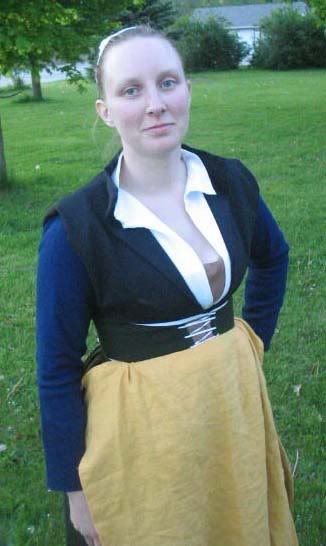
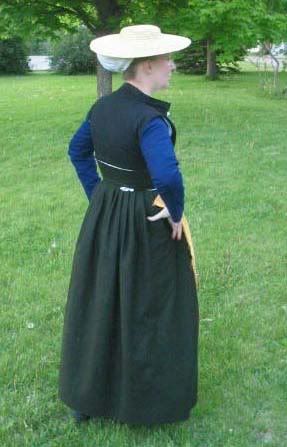
| Flemish Market Woman v1.0 circa 2008 |
Reenacting is a time consuming, money devouring, all encompassing hobby. Really the only ways to go about fully developing a complete, historically accurate impression is either to be some kind of independently wealthy play-boy who really likes old stuff, or to take your time & allow the kit to grow & evolve with you.
5 years ago, I set about making a
Flemish Market Woman's outfit, not because I had any special plans for it to become a long term part of my reenacting hobby, but because my friend Kass, the force behind
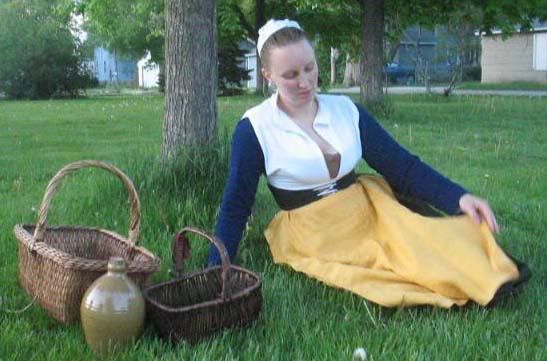
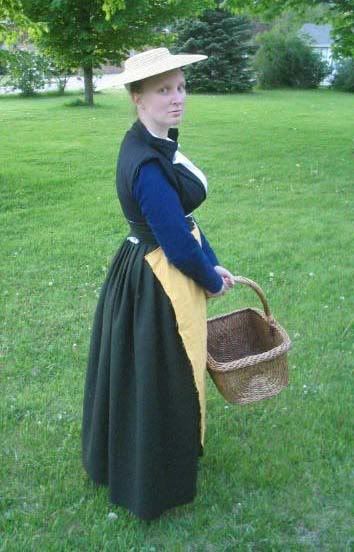
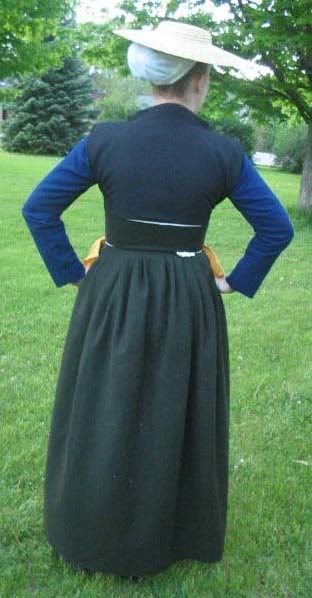
Reconstructing History, had some ideas about the cut of the clothes that I couldn't believe without seeing for myself. In the week before a local Renaissance Faire, I managed to put together a fairly accurate, comfortable outfit. But, because of the time constraint & the fact that I didn't intend to wear the outfit more than once or twice, I didn't really worry too much about making every accessory. My kit was bare bones, filled in with a few choice pieces (petticoat, shift, stockings & shoes) borrowed from my 18th century wardrobe. I even went so far as to borrow my 18th century straw hat & scrounged all the baskets, pottery & containers I could find in all my other reenacting periods just to fill out the impression without having to do any new purchases.
 |
| Flemish Market Woman v1.0 circa 2008 |
That is where my Flemish Market Woman sat until 2012. Sure I would wear it every year to the local Renaissance Faire or winter trade show, but I never needed to move beyond that very simple, half borrowed kit. That was until some friends invited me to the Bristol Renaissance Faire for a day of drinking & debauchery (mostly drinking).
Suddenly, I was seeing all the flaws in my quick costume! The pinned on sleeves were just a tad to short. I really needed the black partlet to help hold my bust at the right height. My old 17th century men's shoes were no where near what would have actually been worn at the time. Worse, some of the short-cuts I had taken to get the clothes wearable, were starting to actually damage that same wear-ability. Most notable was the constant poking of the lace through the front of the kirtle. Sure it meant that I didn't have to sew lacing rings or eyelets at first, but the more I wore it, the more those holes tore the fabric. Clearly it was time to consider up grading my Flemish Market Woman kit.
 |
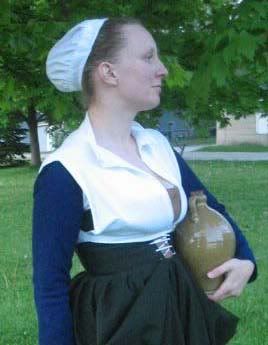
| Flemish Market Woman v2.0 circa 2012 |
First up were the shoes, I had a pair of wooden shoes I had purchased on a whim in Holland, MI several years earlier. While I can't definitively say that Flemish Women wore these shoes, their feet don't appear in images all that often or clearly, there was a pair much like mine in
Pieter Aertsen's "The Egg Dance" painting from 1557. Since they were already in my wardrobe, & frankly not getting used for anything more than a door stop, I decided to use them. As it turns out, the public is awed by wooden shoes. I would get stopped no matter where I was going by multiple people with the usual question "Are those comfortable and/or hard to walk in".
Next up was a quick replacement pair of pin on sleeves. This time from some nice burgundy wool that was floating around in my fabric stash. I added a bit to the length to solve the too short problem of the previous pair & called them done.
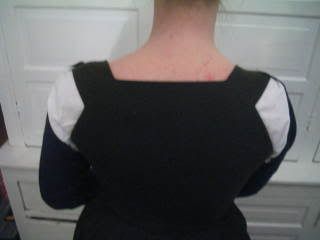
The black partlet had been made during the first incarnation of the Flemish Market Woman's outfit, but for some reason, I hardly ever wore it. This time around I did, layering it over the plain white partlet. This gave me both just enough extra support in the bust but also brought the look even closer to that seen in many genre paintings from the era.
 |
| Flemish Market Woman v2.0 circa 2012 |
Now that all the old pieces were starting to look better, I decided to add a few more dedicated accessories & details to enhance the impression. Rather than wearing the bright yellow apron, I began tucking the front of the kirtle into my waist tie. This creates the very distinctive double layer look seen in paintings & quite frankly, is a lot cooler on hot summer days at Bristol than wearing the wool portion down all the time.
The last new addition to the second incarnation of the Flemish Market Woman was the "Rams Horns", or wired coif, worn on the head. This had seemed like such a daunting piece of clothing when I first made the outfit that I hadn't even
considered making one. Boy was I wrong! It is nothing more than a rectangle of nice linen, with a wire sewn to the front edge. Of course, all that rolled hemming around the sides of the rectangle was enough to make me need a stiff drink, but once finished, ironed & starched, it was well worth the effort. The biggest obstacle was learning how to fold it up & over my head, pin it in place & get it to stay there. Nothing adding a few more straight pins doesn't fix!
 |
| Flemish Market Woman v2.5 circa 2013 |
It was about this time that I realized that for all the years I had worn this outfit, I still hadn't made the distinctive red jacket. It was that jacket that I really liked & seemed to gravitate towards in paintings. Yet it was the one piece missing from my own wardrobe. Of course, up until this year, every event that I wore the Flemish Market Woman outfit to had been during a hot, usually close to 90*, summer day. There was no real need for another layer of clothing. The Early Modern Muster of Arms in April was about to change that!
The Early Modern Muster of Arms (EMMA) would be my first over night camping experience with the Flemish Market Woman impression. Add to that the events focus on first person immersion, the potential for temperamental Midwestern spring weather & my growing interest in the slightly later 1580's era and you naturally get a reason to make that missing red jacket.
It was during a group sewing day that I finally pulled out the vivid red wool broadcloth I had purchased from
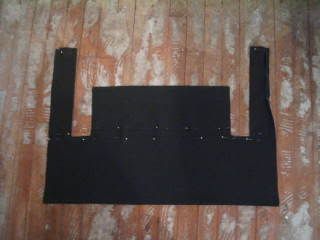
Wm. Booth Draper just for this project. The jacket itself is more of an origami project than a sewing one, much like the matching kirtle. However, it was also extremely easy to make. I decided that this would be a good project to try out a new seam finishing technique that I had recently read about,
the Elizabethan Seam. After all, I would be hand sewing the jacket anyway & there weren't any places where this seam treatment would interfere with pieces or shaping. The jacket is, after all, mostly a big folded rectangle with big rectangle sleeves.
 |
| Flemish Market Woman v2.9 circa 2013 |
Along with finally making the red jacket, I added a proper pair of leather shoes for the impression which were much safer while working in the kitchen than my usual wooden shoes. I also became determined that I had to have a new white partlet with a ruffled neck for EMMA. Little did I recall how much "fun" rolled hems are. Nor did I consider the sheer length of fabric that is needed to create a properly ruffled neck! As the event came & went, I was still hemming on that darned ruffle.
By the opening of Bristol in June of this year I had finally, after much swearing & a few very long movie marathons, finished the hemming, gathering, sewing, starching & shaping needed to finish the ruffled partlet. All that work for something that can barely be seen in a photograph! Oh well. It looks fantastic when worn & is spot on for what we see in paintings from the later portion of the 16th & early 17th centuries. The best part is now that I have made one, I don't have to consider making another for long, long time. Hopefully by then I will have forgotten just how much work it really takes to make one.
As you can see, over the years my Flemish Market Woman impression has grown & developed. It started out highly authentic, hand sewn from linen & wool & based on solid research into art of the time. But for as good as it was, there were still improvements to be made and pieces that could be added as time, interest & need allowed. This just goes to show that while it might be exciting to start reenacting a new time period (or at all), not everything has to happen at once. Heck, sometimes it takes years!
What's next for the Flemish Market Woman's impression you ask? Cloth hose, a nicer cap to wear under the coif, maybe another new pair of sleeves since I accidentally threw the burgundy pair in the dryer. Who knows. Just like with the evolution of life, sometimes the evolution of an impression just has to happen the way it happens.
Labels: 16th Century, Event Photos, Women